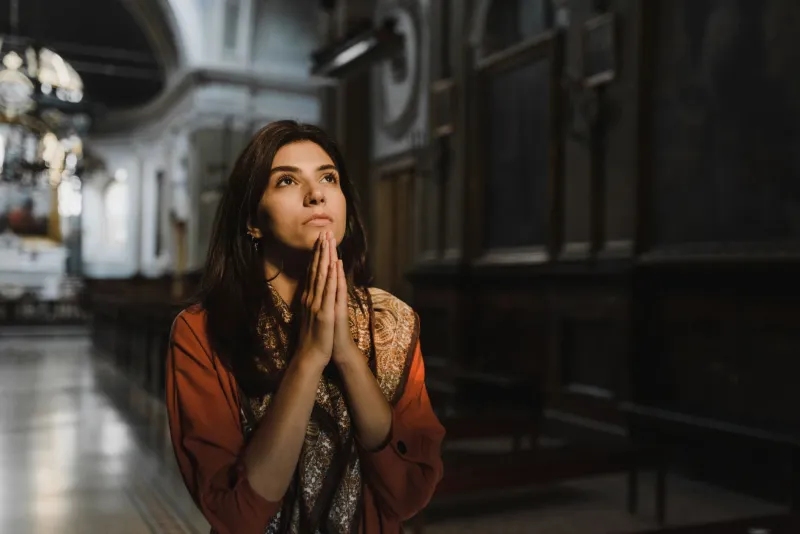
What Divine Silence Is Actually Saying to You

Photo: Lu Zhi, CC0, via Wikimedia Commons
There is a particular kind of loneliness that belongs only to the person who has prayed fervently and heard nothing back. Not a whisper. Not a sign. Not even the faint impression that someone, somewhere, received the transmission. You kneel, or sit, or cry in your car on the way home from work, and the silence that greets you feels less like peace and more like abandonment.
Most spiritual traditions offer some version of comfort for this experience. God is listening. Trust the process. The answer will come in time. These assurances are offered with genuine care, and yet they often land hollow when you are deep inside the waiting. What if, rather than treating silence as a temporary gap between question and answer, we entertained the possibility that silence itself is the answer—and one of the most instructive ones available?
The Assumption We Bring to Prayer
American spiritual culture, shaped by a long tradition of revivalism and the prosperity gospel's cultural residue, tends to treat prayer as a transaction. We bring our need; we expect a response. The model is closer to a customer service call than a contemplative encounter. When the line goes quiet, we assume we have been placed on hold, or worse, disconnected entirely.
But this framework may fundamentally misunderstand what conversation with the divine is for. If God, or the sacred, or whatever name you give to the deepest intelligence of the universe, were primarily in the business of dispensing answers, the entire architecture of human spiritual development would look quite different. There would be no dark nights of the soul documented across every major tradition. There would be no mystics who spent decades in uncertainty before arriving at anything resembling clarity. The silence would simply not exist.
That it exists so consistently, across so many lives and traditions, suggests it may be load-bearing.
Silence as Spiritual Curriculum
Consider what unanswered prayer actually requires of a person. It demands that you remain in relationship with a question rather than retreating into the comfort of resolution. It asks you to develop tolerance for ambiguity—arguably the most essential skill in any mature spiritual life. It invites you to examine what you actually believe, stripped of the reassurance that your beliefs are being externally validated.
In this sense, divine silence functions less like neglect and more like the silence of a skilled therapist who resists filling every pause. The pause is where the real material surfaces. When no one rushes to answer your question, you are left alone with the question itself, and that encounter often reveals something far more important than any answer could.
The contemplative traditions understood this intuitively. The Desert Fathers and Mothers of early Christianity deliberately sought silence not as an absence of God but as the condition most hospitable to genuine encounter. Quaker worship is built on the radical premise that truth emerges from collective stillness rather than from instruction. Buddhist meditation practice treats the quieting of the answer-seeking mind as the entire point.
When Waiting Is the Work
There is a meaningful distinction between passive resignation and active waiting. Resignation says: nothing is happening, so I will disengage. Active waiting says: something is happening that I cannot yet perceive, and my task is to remain present and attentive.
This posture transforms the experience of unanswered prayer entirely. Instead of measuring spiritual health by the frequency of divine response, you begin measuring it by the quality of your attention during the silence. Are you learning to sit with discomfort without immediately reaching for distraction? Are you discovering what you genuinely believe when the scaffolding of reassurance is removed? Are you developing a relationship with the sacred that does not depend on constant confirmation?
These are not small achievements. In a cultural moment defined by instant information, algorithmic personalization, and the expectation that every question deserves an immediate answer, the capacity to wait well is genuinely countercultural. It may also be one of the most spiritually sophisticated things a person can do.
The Message Inside the Absence
If we grant that silence communicates, the next question becomes: what, specifically, is it saying? The honest answer is that this varies by person and circumstance. But several common themes emerge across spiritual accounts of sustained silence.
Sometimes silence communicates that the question being asked is not yet the right question. We arrive at prayer with a specific request—clarity about a relationship, guidance on a career decision, relief from pain—and the silence redirects us toward something deeper. Not because our request is unimportant, but because beneath it lies a more fundamental inquiry that we have not yet found the courage to voice.
Sometimes silence communicates that we already know the answer and are seeking external permission to act on it. The divine, in its peculiar wisdom, declines to grant that permission, leaving us to discover our own authority.
And sometimes silence communicates something that resists translation into language: a quality of presence that is not information but is, nonetheless, real. Many who have moved through extended periods of spiritual silence report that what eventually emerged was not an answer but a changed relationship to the question itself. The urgency softened. The need for resolution dissolved. What remained was something quieter and more durable than certainty.
Reframing the Unanswered Prayer
This is not an invitation to spiritual bypassing—the practice of using elevated frameworks to avoid genuine pain. If you are suffering, that suffering is real, and no reframing eliminates it. The silence can be genuinely agonizing, and anyone who tells you otherwise has likely not spent much time inside it.
But alongside the acknowledgment of pain, there is room for a different question. Instead of asking why God is not speaking, you might ask what the silence is making possible in you. What is growing in the space that answers would have filled? What are you learning about your own resilience, your own capacity for faith without confirmation, your own relationship to uncertainty?
These questions do not resolve the silence. They do, however, change your relationship to it. And changing your relationship to the silence may be precisely the spiritual work this season is asking of you.
The conversation God is not having with you may, in the end, be the most important one you will ever learn to hear.