God in the Ordinary: 5 Everyday Moments That Are Actually Spiritual Encounters in Disguise
There is a persistent myth, quietly embedded in much of American religious culture, that the sacred and the ordinary exist in separate compartments. That the divine shows up on Sunday mornings, or during formal prayer, or perhaps during a mountaintop retreat — but not, presumably, while you are making dinner or sitting in traffic or crying in a parking lot after a difficult phone call.
This assumption, however well-intentioned, may be one of the most spiritually limiting ideas we carry. Across traditions as diverse as Zen Buddhism, Quaker Christianity, Indigenous animism, and Jewish mysticism, the core teaching is strikingly consistent: the sacred does not confine itself to sacred spaces. It permeates everything. The work, for us, is learning to recognize it.
What follows is not a list of exotic practices or esoteric disciplines. It is an invitation to look again at the life you are already living — and to discover that it has been offering you spiritual instruction all along.
1. Cooking a Meal: The Sacrament of Transformation
There is something almost miraculous about the act of cooking that we tend to overlook entirely because we do it so often. Raw, separate ingredients — cold, inert, apparently unrelated — are combined through heat and attention and transformed into something nourishing, fragrant, and alive with flavor. Nothing about the original components predicts the final result. Transformation, not assembly, is the operative word.
This is, if you pause to consider it, a remarkably accurate metaphor for spiritual growth. We arrive at our interior lives as raw material — our wounds, our gifts, our fears, our longings — and through the slow application of attention, practice, and time, something new emerges. Something that could not have been predicted from the ingredients alone.
Many contemplative traditions have recognized this. The Zen concept of soji — the practice of treating mundane chores as meditative acts — transforms cooking from a task to be completed into a ritual to be inhabited. Brother Lawrence, the seventeenth-century Christian mystic, famously reported experiencing the presence of God as vividly while washing pots as during formal prayer.
The next time you cook, try this: put the phone away. Turn off the podcast. Let the chopping, stirring, and tasting be the only thing happening. Notice what arises in that quiet attention. You may find that the kitchen has been a chapel all along.
2. Walking in Nature: The Sermon That Requires No Words
Americans spend an estimated 93 percent of their time indoors. This statistic carries spiritual implications that extend well beyond the physical health concerns it typically raises. When we systematically remove ourselves from the natural world, we also remove ourselves from one of humanity's oldest and most reliable sources of sacred encounter.
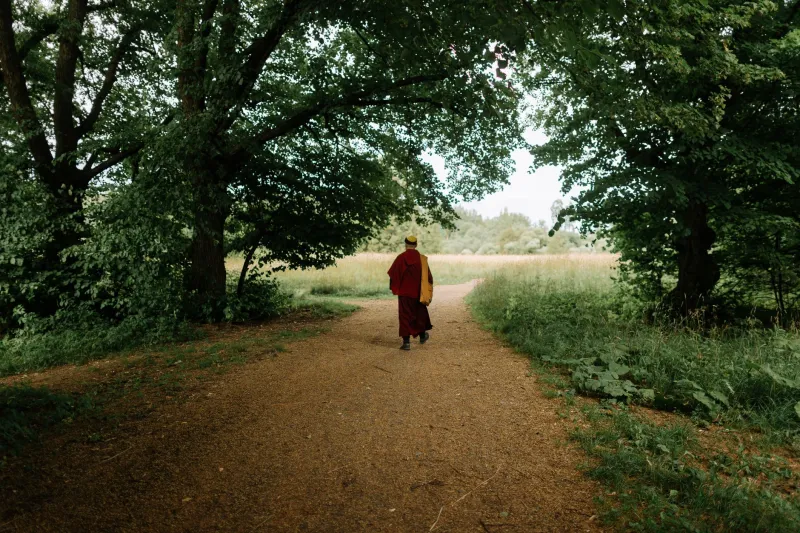
Every major wisdom tradition has sent its seekers into the wilderness at some point. And while most of us are not called to forty days in the desert, a deliberate walk outdoors — genuinely attentive, free from earbuds and screens — offers access to the same essential teaching: that there is an order, a beauty, and an intelligence operating in the world that did not originate with human beings.
Watching a hawk ride a thermal above a midwestern prairie. Noticing the way morning light moves through oak leaves. Feeling the particular silence of a snowfall. These experiences, when met with openness rather than distraction, have a way of relocating us within a larger story — one in which our anxieties and ambitions, however real, occupy a proportionate rather than all-consuming place.
This is not sentiment. It is what mystics call perspective — and it is available on any trail, in any city park, to anyone willing to look up from their phone long enough to receive it.
3. Having a Difficult Conversation: The Crucible of Authentic Presence
Few experiences feel less spiritual in the moment than a hard conversation — the kind where something true and uncomfortable must be said, or heard, or both. Yet these exchanges, navigated with honesty and care, consistently prove to be among the most transformative encounters available to us.
The spiritual teaching embedded in difficult dialogue is this: genuine presence with another person, especially when that presence costs us something, is one of the most direct expressions of love available to human beings. The philosopher Martin Buber called this the I-Thou encounter — the moment when we cease treating another person as an object in our story and recognize them as a full, sacred subject in their own.
This recognition does not come easily. It requires that we set aside the ego's instinct to defend, deflect, and dominate. It asks us to listen not merely for an opening to respond, but with genuine curiosity about the interior life of the person before us. That quality of listening — humble, patient, truly open — is, by most spiritual measures, an act of profound reverence.
The next hard conversation you face may not feel like a spiritual practice. But approached with that intention, it becomes one.
4. Listening to Music: The Frequency of the Transcendent
Music occupies a unique position in human experience — it bypasses the analytical mind almost entirely and speaks directly to something older and deeper within us. Every culture in recorded history has used music as a vehicle for spiritual expression, from the chanting of Gregorian monks to the ecstatic percussion of West African ceremony to the gospel choirs of Black American churches, whose music has shaped the soul of an entire nation.
What happens when a piece of music stops you — truly stops you — and something opens up inside that you cannot quite name? Theologians and neuroscientists alike have struggled to fully account for this phenomenon. But the experience itself is unmistakable: a momentary dissolution of the boundary between self and something larger. A sense of being held within a beauty that exceeds your individual life.
This is not mere aesthetics. It is encounter. The next time a song reaches you in that particular way, resist the urge to immediately identify it, share it, or analyze it. Simply remain in it for a moment. Let it do what it came to do. You may find it has something specific to say to you — something that no sermon or self-help book could have delivered in quite the same way.
5. Grieving a Loss: The Unwanted Teacher Who Changes Everything
Of all the experiences on this list, grief is the one most likely to be met with resistance. It does not feel like wisdom. It does not feel like a spiritual portal. It feels like devastation — and that feeling is entirely valid and must be honored before anything else is said.
And yet. Grief, by its very nature, is a testimony to love. You cannot grieve what did not matter. The depth of loss corresponds directly to the depth of attachment, and attachment — in its truest form — is one of the most spiritually significant capacities we possess. To love something or someone so fully that their absence reshapes your world is, in the most literal sense, a measure of how alive you have been.
Every wisdom tradition holds grief as sacred. Judaism prescribes shiva — a structured period of communal mourning that insists the community surround the bereaved rather than leave them to process loss in private. Buddhism teaches that impermanence is not a problem to be solved but a truth to be received, and that receiving it fully is the beginning of liberation. The Christian tradition holds that death itself is not the final word.
Grief also strips away what is nonessential with a thoroughness that no other experience can match. In the wake of significant loss, many people report a sudden and clarifying awareness of what actually matters — relationships, presence, meaning — and a corresponding release of what does not. This restructuring, painful as it is, constitutes genuine spiritual growth.
The Sacred Is Already Here
The invitation in each of these five experiences is the same: to shift from autopilot to attention. To move through your own life with the quality of presence that recognizes ordinary moments as potentially extraordinary ones. The divine, by most accounts, is not hiding. It is embedded in the texture of daily existence, waiting to be noticed by anyone with the eyes to see it.
You do not need to travel anywhere. You do not need a new practice, a different tradition, or a more spiritual life than the one you already have. You need only to bring genuine attention to the life that is already yours — and to remain open to what it has been trying to teach you all along.